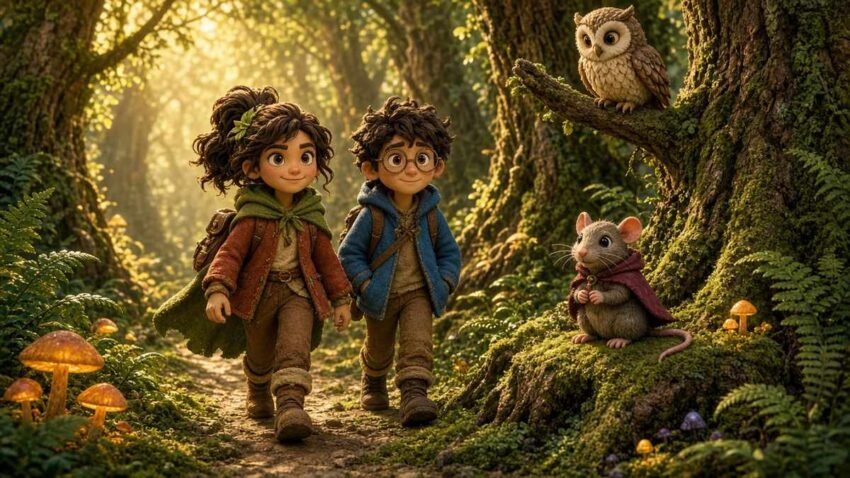
Some movies are made in months. Wildwood took more than five years, thousands of tiny handmade props and a small army of puppeteers moving characters a fraction of an inch at a time. Laika’s long-awaited new stop-motion feature opens in theaters today, October 23, and it is the Oregon studio’s first film since Missing Link back in 2019.
For fans of Coraline, ParaNorman and Kubo and the Two Strings, that gap has felt very long. The good news is that Wildwood is big in every sense. It runs over two hours, carries a reported budget of around $100 million and fills its forest with more creatures, kingdoms and battles than any Laika film before it.
A story that starts in a playground
The film is based on the 2011 novel by Colin Meloy, frontman of the indie band the Decemberists, with illustrations by his wife, Carson Ellis. It follows Prue, a restless twelve-year-old from the Portland suburbs voiced by Peyton Elizabeth Lee. Her parents, played by Jake Johnson and Maya Erskine, have one strict rule: her baby brother Mac never leaves the house. Of course Prue takes him out anyway, and in a playground a swarm of crows swoops down and carries him off into the Impassable Wilderness, a forest locals are told never to enter.
Prue goes in after him, joined by her nerdy, nervous classmate Curtis, voiced by Jacob Tremblay. Inside the woods they find a whole hidden world: uniformed coyote soldiers, a band of outlaws, a proud eagle general, a grumpy old owl and a rat who turns out to be braver than anyone expects.
One of the year’s most stacked voice casts
The cast list reads like an awards-season party. Carey Mulligan plays the mysterious Dowager Governess, Mahershala Ali leads the bandits, Angela Bassett commands the eagles and Awkwafina voices the scene-stealing rat Septima. Tom Waits, Charlie Day, Richard E. Grant, Amandla Stenberg and Tantoo Cardinal also turn up, and the Decemberists contribute a new song for the film.
Behind the camera, Laika CEO Travis Knight directs from a script by the studio’s regular writer Chris Butler. In an unusual move, veteran cinematographer Caleb Deschanel, a six-time Oscar nominee, shot his first animated feature here. Several reviewers say his lighting makes the puppets feel almost like live action.
Gorgeous, but is it magic?
Critics are not completely united. The Hollywood Reporter called it stupendous in every respect, and Variety described it as Laika’s most ambitious feature yet, a richly textured fairytale epic. Deadline praised it as a visual knockout with real emotional weight. On the other side, IndieWire felt it was the least enchanting Laika film despite its incredible craft, and the Associated Press found the story weaker than the visuals. A common note is that the plot borrows familiar pieces from Narnia, Tolkien and Labyrinth.
Even the mixed reviews agree that the craftsmanship is extraordinary. Every patch of moss, every feather and every crooked branch was built by hand, and you can feel that care on a big screen in a way that is hard to match at home.
A note for families
Parents should know the film is rated PG-13. The crow attack in particular has been compared to Hitchcock’s The Birds, so very young kids may find parts of it scary. For older children and teenagers, though, it looks like a perfect autumn adventure: a story about grief, courage and a sister who refuses to give up.
Box office trackers expect a modest opening of roughly $6 million to $10 million against heavy competition from Clayface and You Can See Everything. Laika films have a long history of finding their audience slowly, though, and this one may grow by word of mouth well into the holidays.