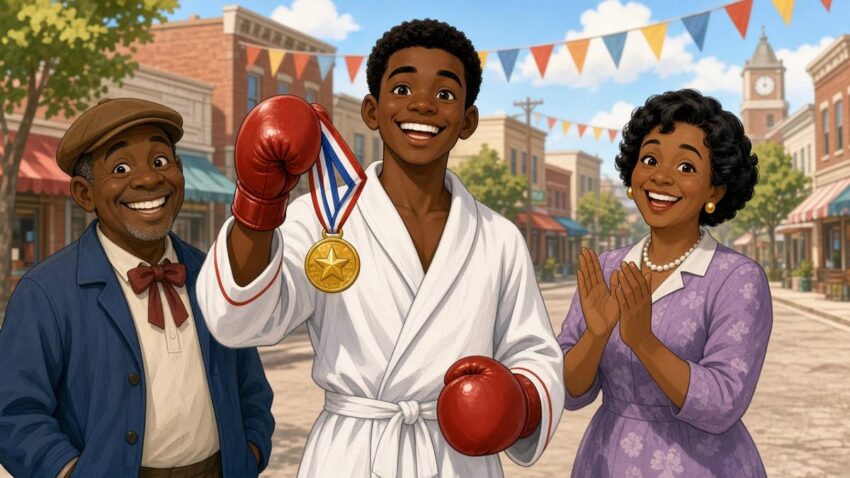
Some stories are so big that television keeps circling them for decades, waiting for the right angle. With The Greatest, which premieres today, November 4, on Prime Video, the angle is refreshingly narrow: not the whole sprawling life of Muhammad Ali, but the four years in which a gifted, loud and still uncertain kid from Louisville became the man who would claim that title for himself.
From Rome to Miami in eight episodes
The series opens in 1960, right after 18-year-old Cassius Clay wins the light heavyweight gold medal at the Rome Olympics. It closes in 1964, when the 22-year-old defeats Sonny Liston in Miami for the world heavyweight championship and tells the world his name is now Muhammad Ali. Everything in between gets room to breathe across eight episodes: the hometown parade, the early professional fights, the bruising night in London against Henry Cooper, and a young man learning how to hold a microphone as confidently as he holds his guard.
That compact timeline is the show’s smartest decision. Reviewers at the Los Angeles Times and RogerEbert.com both point out that by stopping at the Liston fight, the series avoids the rushed, greatest-hits feel that so many biopics suffer from. The later chapters, from his refusal of the Vietnam draft to his comebacks and activism, are presumably being saved for future seasons.
A breakout performance, not an impression
The name everyone is talking about this morning is Jaalen Best. Playing one of the most imitated public figures of the twentieth century is a trap for any actor, and critics agree that Best sidesteps it. The Hollywood Reporter calls his turn star-making, praising how he builds Clay’s voice from a soft Kentucky lilt into the rhyming, crowd-baiting trumpet the world remembers. The A.V. Club highlights the quieter moments too, such as a charmingly awkward attempt to ask out a crush, which show the vulnerable teenager underneath the swagger.
Best is surrounded by a strong ensemble that includes Omari Hardwick, Dana Gourrier, Kai Parham and Amin Joseph. The show was created by Ben Watkins, known for Cross, and counts Ali’s widow, Lonnie Ali, among its executive producers, which explains why it is billed as the first authorized scripted series about the champion’s life. The finale is directed by A.V. Rockwell, whose film A Thousand and One earned wide acclaim.
Fights that actually feel like fights
Boxing drama lives or dies in the ring, and here the reviews are close to unanimous. Several critics say the fight sequences are among the best ever staged for television, and that they track the historical footage closely enough that you can compare them side by side with archival clips of the Cooper and Liston bouts. The show also experiments with dreamlike black-and-white interludes when Clay is hurt or lost, a stylistic choice that gives the drama an inner life beyond punches and press conferences.
Not everything lands perfectly. Some writers find the social messaging heavy-handed at times, and a few supporting portraits of historical figures feel stiff. But even the more cautious reviews come back to the same conclusion: the early 1960s were a heavy era, the show is honest about the racism a gold medalist still faced in his own hometown, and Best keeps the energy high whenever the script dips.
Why it is worth your evening
Sports biopics often treat their heroes like statues. The Greatest seems more interested in the clay before it hardened: the doubts, the family dinners, the church pews and the first flashes of a showman discovering his power. If the reviews are right, Prime Video may have found both a prestige drama and a new leading man in one stroke. All eight episodes are streaming now.